



Mansion Tax Explained
 27th January 2026
In the recent Budget there was the announcement of a new “Mansion Tax” to affect properties in England valued at over £2 million from April 2028, which will allow for the government to assess which properties will actually be liable. It is estimated that around 145,000 properties meet the description of high value and will be affected, with around 80% of these properties being in London and the South East. Unlike Council Tax, the mansion tax will be paid directly to the Treasury and not local authorities, where it will be used for government spending.
Property valuations will begin during 2026, and the Valuations Office Agency will be targeting the highest bands of F, G and H. Valuations of high-end properties can be complex due to the uniqueness of the properties. It has not been made clear on how these properties will be valued or how often the revaluing will take place. It is also expected that there may be a downward price trajectory of properties around the £2 million price mark. This may lead to a price “bunching” of properties just under the threshold of £2 million in hopes that this will help avoid the surcharge.
It is estimated that the new mansion tax will raise around £400 million in additional taxes per year by 2029-2030 and tax rate paid will be dependent on the properties value:
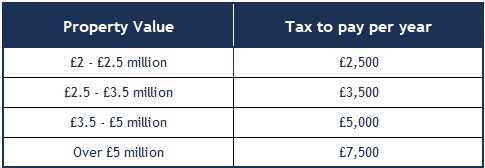
The amount of tax paid is expected to rise each year in line with the Consumer Price Index (CPI) rate of inflation.
Unlike Council Tax, the new mansion tax will be paid by the owner and not the occupant, as such landlords who own high value properties will have to pay the extra fees. It is likely that landlords will have no choice but to pass the additional fees onto their tenants through increased rent.
As this tax has just been announced, there are still plenty of specifics that have not be released. We will follow up as more information becomes available.